Invisible Artwork
All photos by: Julianna Nyíri
Talking about making art as work still provokes resistance and discomfort in certain circles. In Pierre Bourdieu’s terms, art is based on a denied, otherwise known as inverse economy. The artist must first assert himself independently of wages, achieving professional success, and only then can he receive financial benefits, which are therefore framed as rewards, not wages. However, this “reward” is also not evident, automatic and regular, while the artist’s livelihood – like that of anyone else – involves regular costs. Bourdieu calls the process that creates belief in the symbolic value of art, but at the same time hides its economic value, “consecration”. There is no alternative option, unless the artist wants to be branded as commercial, which entails the loss of artistic value. The result of this is the cultural view that a work of art created on commission, that is, in exchange for money, is suspicious, vulnerable, and loses its autonomy. (Bourdieu, 1983)
According to the American sociologist Eliot L. Friedson’s 1990 article Labors of Love in Theory and Practice: A Prospectus, artistic work should be interpreted as something we do for pleasure, love, or passion (labor of love) and which means freely chosen, alienated work that allows for self-realization. (Friedson, 1990) Thus, artistic practice is the expression of the inner self that comes naturally, not work that should be paid for, but self-expression, and can even be self-therapy. Later, of course, this may also benefit others, and this is a desired, but at first an arbitrary process, an unstoppable revelation of the inner self that should be admired, not paid for. (Unpaid) art is born of passion and not economic considerations. (Friedson, 1990)
According to Edward A. Ross, artistic practice can be interpreted as sacrificial labour as a type of cultural and mental work that is based on the economic sacrifice of the worker. (Ross: 2000) It is work whose practitioners are accustomed during their training to sacrifice their money and time to practice their craft. (Ross: 2000) Ross links this self-sacrificing work to left-wing integrity, in a monastic way, accompanied by the commitment to “material self-denial and voluntary poverty”. (Ross, 2000) Thus, the fact that they feel their work is remunerated in other, non-economic terms (e.g., aesthetic, cultural, social or political terms) not only makes exploitation acceptable, but also expects it, thus normalizing it.
In her 2021 book Artwork – Invisible labour and the Legacy of Yugoslav Socialism, Katja Praznik argues that the mere fact that work is profitable or satisfying does not justify not paying for it, although both Ross and, to some extent, Friedson appeal to this in their interpretations. Interpretations that portray artistic practice as a labor of love or as a labor of sacrifice reinforce exploitation, do not address class differences, and ignore the material and social relations that govern artistic production. The “privatization of work” in our society obscures the fact that work is both a political issue and a structural condition: it interprets work as a unique relationship between individuals and not as a “social institution” or structure. We interpret the workplace as an individual choice and the satisfaction of an individual’s financial needs, not as a field for the exercise of political power. These ideas related to privatization also permeate the institutional system of art. We consider artistic work to be an expression of the individual. Many artists also believe that they do not do their artistic practice for money, but rather to create some higher, ideal value that is difficult to exchange for money. Works of art are an expression of creativity, a gift to themselves and the world, and the reward is that they are admired and held in high regard. This is an excuse not to pay, while others, gallerists, critics, curators, profit from the creativity of artists. (Seregi, 2021)
According to French sociologist Robert Castel, when examining social capital, we should not view work as a means of production, but as an element of integration into the social structure. Yet today, in the age of global capitalism, the goal is a performance-based society: we measure the success of countries in terms of GDP growth. Thinking about work is therefore based on a market-based logic. According to this, it does not matter whether the purpose of work is to satisfy a real human need. It does not matter whether the worker likes his work or not. The main motivation for work for capitalists is to make a profit, and for workers the faint hope of becoming capitalists, or at least accumulating as much property as possible.
Oxfam’s study on unpaid work within the householdAccording to the report, women around the world spend a total of 12.5 billion hours a day cooking, cleaning and caring for children without being paid; in return, women’s unpaid work contributes $10.8 trillion to the global economy annually, three times more than the entire technology industry. According to the report, unpaid care work is the hidden engine of today’s economy, enabling continuous economic and social growth. More than three-quarters of this work is done by women, who also no longer have the time to further their education or search for a better job; they are often only able to work part-time or not at all. More than 40 percent of working-age women are unable to work at all because the burden of caring for their children or elderly family members falls entirely on them. As a result, they do not have their own income and cannot influence social (economic) decision-making at any level. This is true for only 6 percent of men in the world.
A comparison of reproductive labor and artistic practice reveals the mechanisms that maintain and direct the exploitation of the artist’s work to this day. According to Praznik, there are two aspects of feminist epistemology that resonate with the theory of the exploitation of artistic practice:
1.) the structural nature of invisible labor that divides the domestic, private, and public spheres: the latter as the sphere of production and the former as the sphere of reproduction. (Praznik, 2021) In both cases, value is produced, but the sphere of reproduction is displaced from the economy and remains a field of exploitation. The construction of art as an autonomous action is clearly separated from the noisy bustle of working life and can be inserted into the private sphere, to which women and housework were also exiled during industrialization. At the same time, it transcends the alienated robot of everyday bourgeois work and paradoxically elevates its eventual product (artwork) to a pedestal. It adopts the middle-class, Victorian view of invisible work performed by women, according to which housework is an expression of the selfless self (essentialization), and therefore cannot be alienated from the individual. (Poovey 1988). The separation of public and private spheres makes private work appear as if it were not affected by market logic, thus excluding private work from the economy, making it invisible and depoliticizing it. Although it may seem that both home care and artistic practice can be alternatives to social alienation, they are both based on capitalist logic, reproducing class differences, burnout and alienation.
2.) the essentialization of work and skills, leading to their economic or cultural devaluation. The transformation of housework into a natural attribute of the female subject, an expression of the caring self – that is, its essentialization, naturalization – makes it possible to be unpaid. (Feminine tendency, quintessence of femininity, expression of love, feminine principle.) Similarly, the construction of work as non-work in the case of artistic practice also stems from the nature of the subject: “born genius”. (Praznik, 2021)
Artistic practice can therefore be defined economically in the light of invisible work, as an invisible and at the same time unvaluable form of work, which is operated by fundamental socio-cultural mechanisms, the ideologies of autonomy, creativity, and artistic genius, thereby naturalizing or essentializing the abilities of artists. In line with the view that it is not utilitarian work and is a free means of expression available exclusively to the chosen: talented individuals.
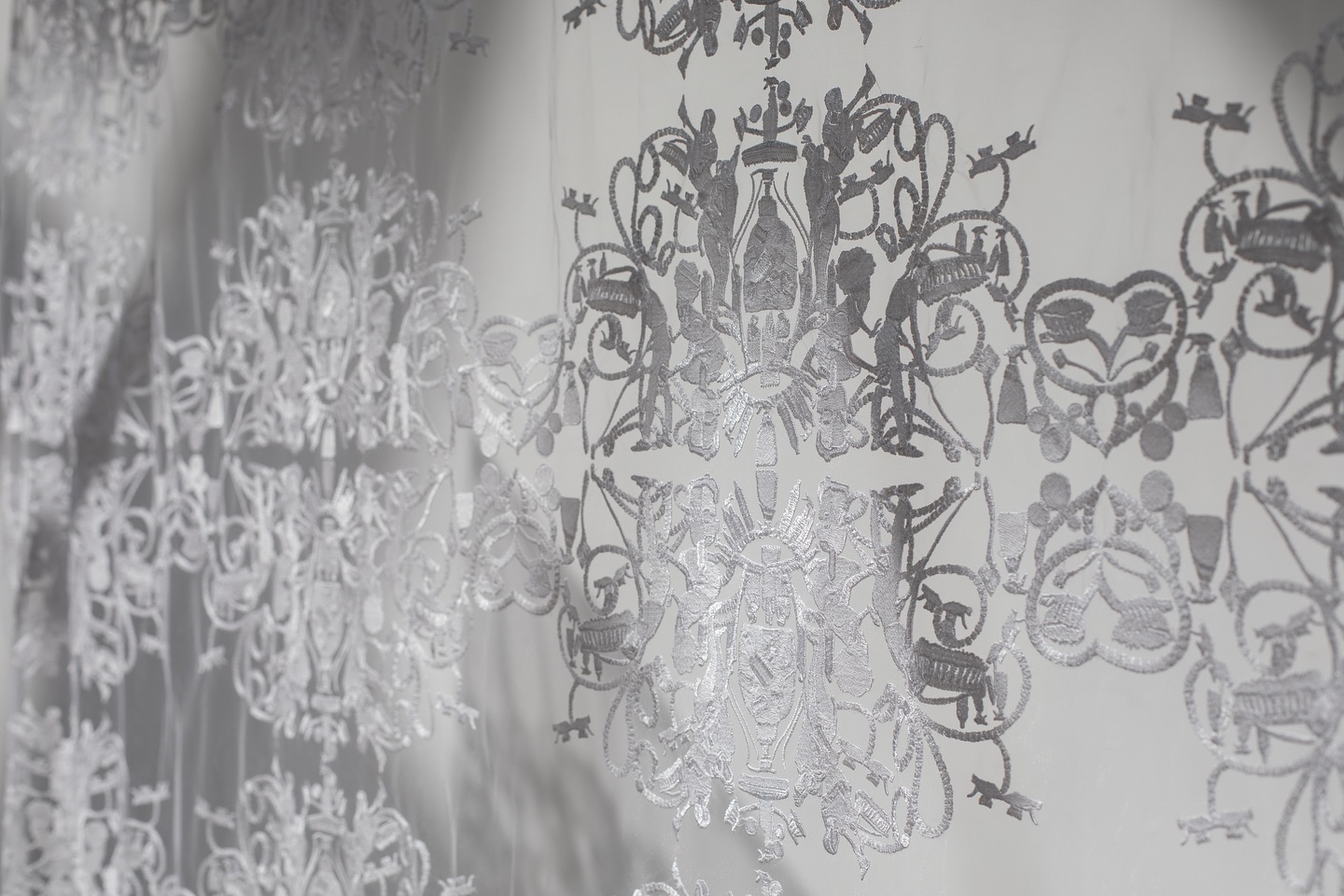
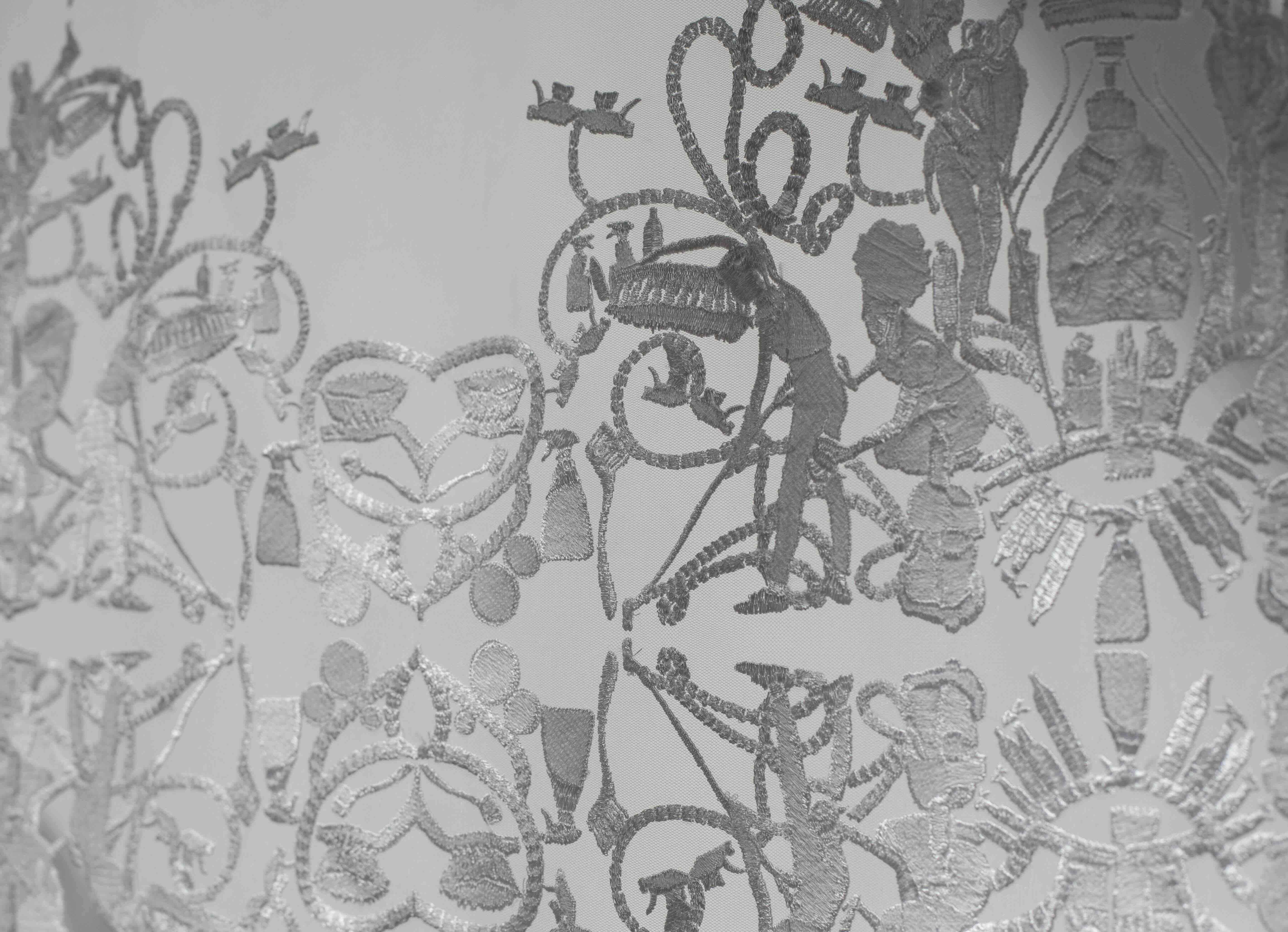
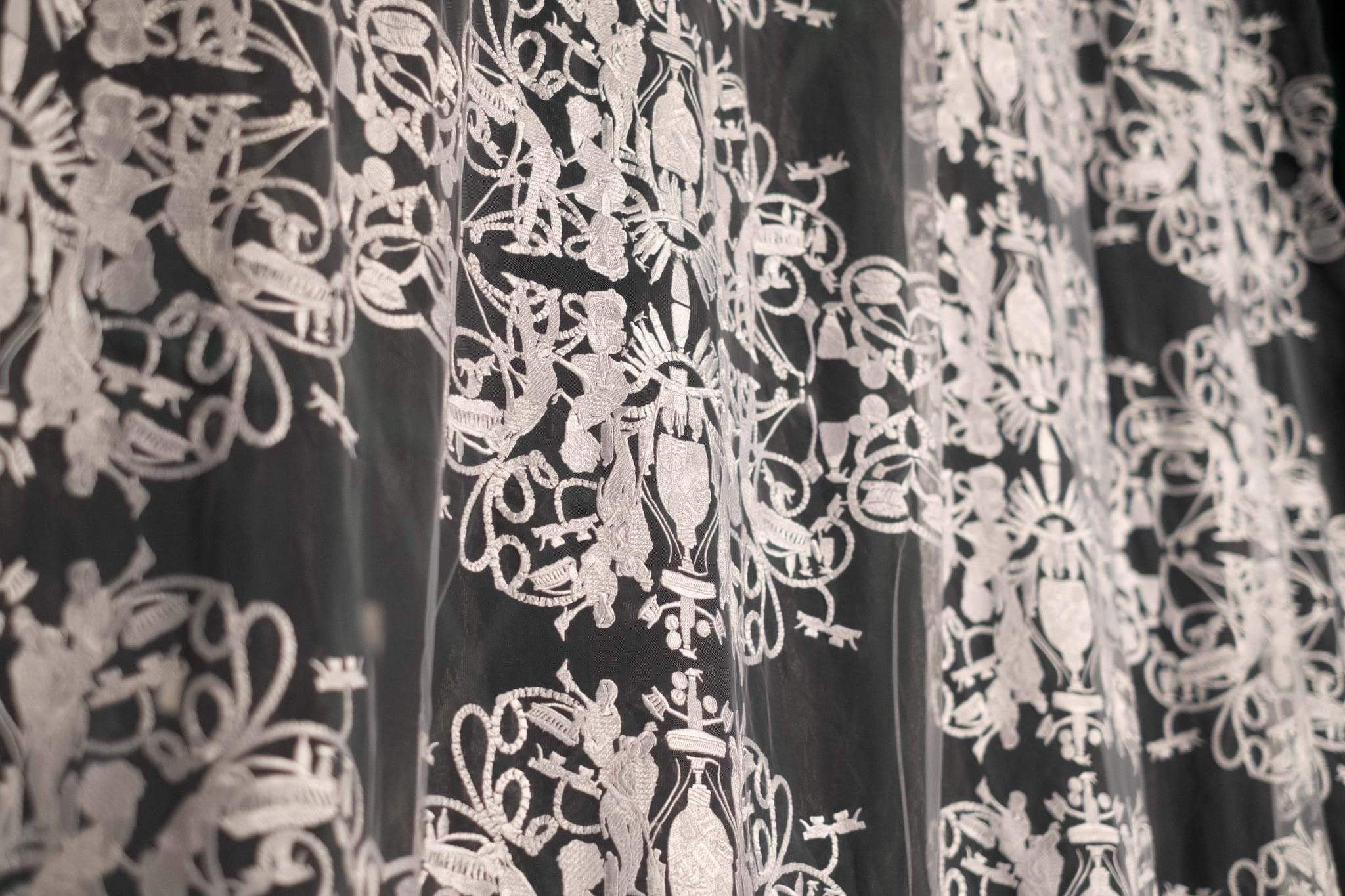
My work Invisible (art)work is a site-specific spatial installation that I designed for the Aula exhibition space of the Hungarian University of Fine Arts. I chose the metaphor of the curtain to represent the helplessness experienced in public life: the economic unrecognition of artistic work and domestic work: it is in front of us, yet we look through it.
A 45x50 cm transformed lace motif is repeated on the embroidered tulle, in which, while maintaining the original composition, I replaced the flower and vine motifs with a winding vacuum cleaner hose, female figures doing housework, and elements made of cleaning products. It is repetitive like housework. In sunlight, the motif becomes visible in the parts that are exposed to the light, while the shaded parts blend into the white of the wall: the work thus becomes partially invisible.